
In This Article
Here’s a quick map of what’s ahead, in case you want to jump to a specific part:
A lot of the estimates homeowners collect over the years say almost nothing.
A project name. A number. Maybe a sentence or two of description. That’s it.
Nothing about what’s included. Nothing about what happens if something unexpected turns up once a wall’s open. No sense of what “done” actually looks like when I pack up and head out.
That makes it hard to line one quote up against another, or to know exactly what you’re saying yes to.
I want you to feel good about the plan, not just the number at the bottom.
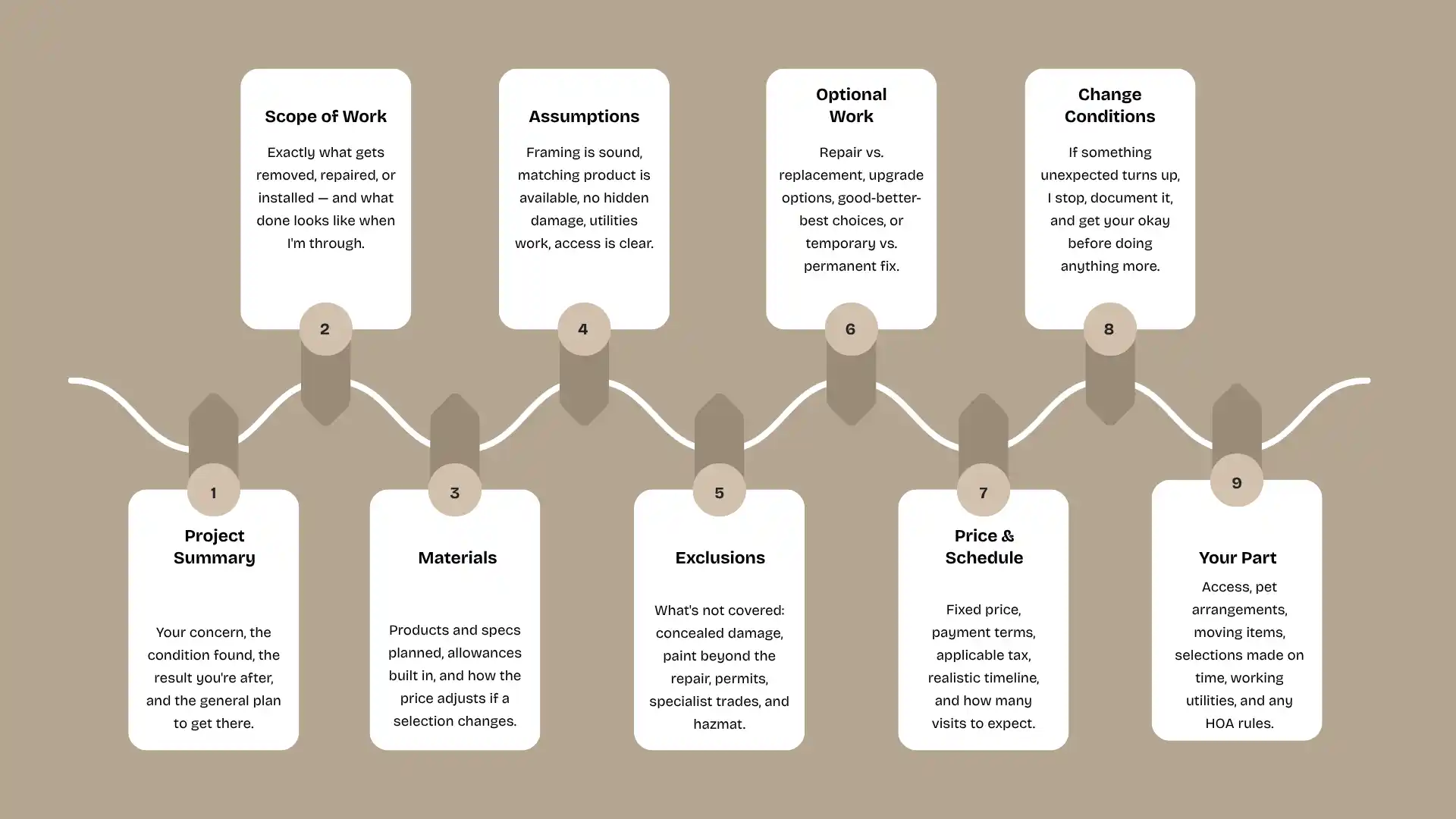
The chart below is a brief glimpse into how I outline project plans inside of quotes.
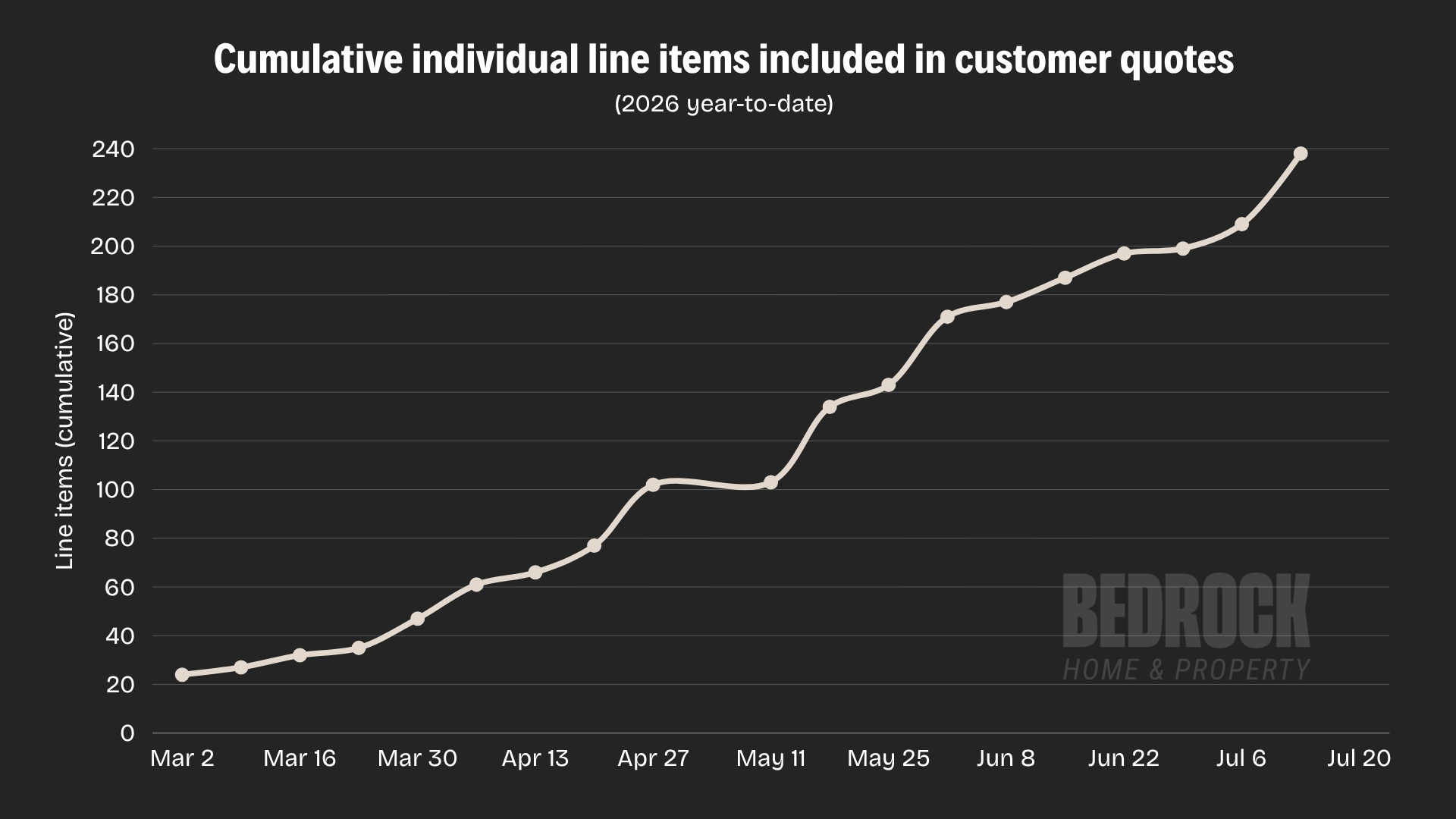
As you can see, a quote from Bedrock won’t leave you wondering.
I intentionally put them together so each one lays out the work, walks you through the result you can expect, and is upfront about what I’m assuming and what’s not included.
It tells you how I’ll handle things if something comes up mid-project, so you always know what’s happening and why.
You should feel like you understand the plan, not just the price.
Here’s how I put together a Bedrock estimate, what goes into the price, and why even a small project can involve a lot more than the time I spend with a tool in my hand.
Every Estimate Starts With Understanding the Project
Before I think about hours or materials, I want to get a real feel for what’s going on at your place.
Pricing comes second. Listening comes first.
I’m trying to understand the problem you’re dealing with, the shape of what’s there now, and the result you have in mind.
Everything else builds from those three things.
The Problem You Face
I want to know what’s damaged, loose, missing, outdated, or just not working right, and how it’s actually affecting your day-to-day. I’m also getting a sense of whether you’re after a repair, a full replacement, some troubleshooting, or a general improvement, and whether this is its own thing or part of something bigger.
Existing Conditions
Then I look at what I’m actually working with: measurements, how easy the area is to get to, the materials around it, any past repairs, wear and tear, how the current piece was put in, any hint of moisture or movement, whether new materials will match what’s there, and anything that might be hiding behind a wall or under a floor.
The Result You Want
Finally, we talk through what matters most to you: how you want it to look, how long you want it to last, your budget, whether finishes need to match what’s already there, how much upkeep you’re up for, and whether you’re after a lasting fix or something to hold you over for now.
That’s why two projects that sound identical over the phone can end up with completely different scopes and prices. A loose deck board on a newer deck is a different project than that same loose board sitting over rot underneath. Same words, different job.
I ask these questions early because guessing wrong here causes headaches later.
If I plan for a simple swap and then find the surrounding material’s failing too, either the price has to change mid-project or you end up with a smaller fix than you actually need.
Neither one feels good.
Getting the picture right up front is what makes the rest of the estimate hold together.
The Scope of Work Defines What Is Being Priced
A price really only makes sense once you know exactly what work it covers.
Two contractors can quote the exact same dollar amount for very different amounts of actual work.
So I break every project into four stages, and I want you to know exactly what “complete” includes before I ever start.
- Preparation. Taking measurements, protecting your floors and surfaces, moving things out of the work area, staging tools, and setting up dust control before anything gets touched.
- Removal and demolition. Taking out what’s failed, carefully disassembling what needs to come apart, dealing with old fasteners and sealant, saving anything worth reusing, and getting debris ready to haul.
- Repair or installation. The actual work: the repair itself, the products going in, fastening things properly, adjusting so everything operates the way it should, matching the finish, and testing it before I call it done.
- Finishing and cleanup. Caulking, touch-ups, putting things back where they were, cleaning up the area, hauling debris, snapping final photos, and walking the finished work through with you.
Every one of those stages takes real time, and every one is part of what you’re paying for, not just the repair step in the middle.
When a quote only describes one of the four, that’s not a lower price.
It’s a smaller promise.
Scope also needs to define what “complete” means before I start, not after. If the project is a cabinet door repair, does complete mean the door closes and latches, or does it also mean the hinge gets replaced so it doesn’t fail again in six months? Those are two different jobs at two different prices, and having it in writing settles that ahead of time instead of leaving it open to guess about once the work’s underway.
I write the scope in plain language, in the order the work will actually happen, so you can picture the whole visit rather than decode a list of trade terms. And if a step depends on what I find once things are opened up, I’ll say so, so the scope stays accurate instead of becoming something I have to explain away later.
What Goes Into the Price of a Small Home Project
A written estimate covers a lot more than the visible repair.
The hour or two of hands-on work you actually see is just one piece of the whole project. Here’s the fuller picture:
Planning → Loading → Travel → Setup → Work → Cleanup → Reloading → Disposal → Documentation
You see the middle of that list.
I’m thinking about the whole thing. (Who doesn’t love a nice Gantt chart, right?)
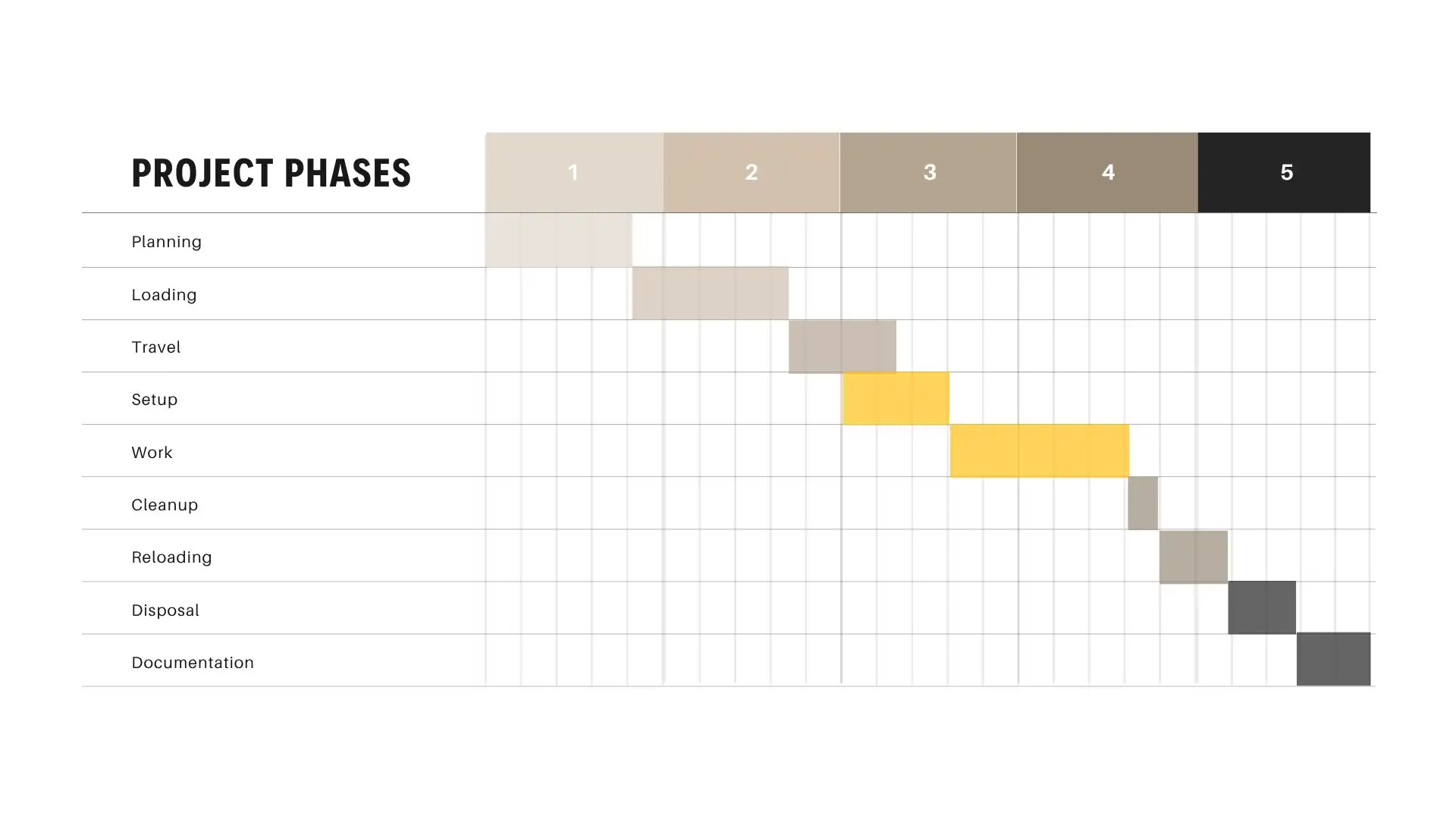
A project that looks like ninety minutes of work from your kitchen window can easily add up to five or six hours of total project time once everything around it is counted.
That time is what it actually takes to get the work done right and safely, whether or not you’re around to see it happen.
The sections below walk through what fills in those extra hours.
I like sharing this with homeowners because once you can see the full picture, the price on the page makes a lot more sense.
It’s the cost of a real system built to do the work well, every time, not just when it’s convenient.
Work-Specific Labor
This is the part you can actually watch: removal, cutting, fitting, carpentry, assembly, installation, troubleshooting, caulking, finishing, testing, and adjustment. Even this piece is bigger than it looks from the outside.
I count the complete task from start to finish, not just the moment the new part goes in. Rushing through the middle steps to save time usually shows up later as a callback, and a callback costs more than doing it right the first time.
- Figuring out exactly what needs to happen before touching anything
- Test-fitting and adjusting until it’s right, not just close
- Finishing touches that make the repair look intentional, not patched
Mobilization and Logistics
Before I ever step onto your property, there’s a stage of work you don’t usually see.
Mobilization is everything it takes to get the right tools, materials, and equipment ready and to your property.
That’s reviewing the project the night before, picking the right tools for the job, loading them into the vehicle, grabbing ladders if I’m working up high, pulling materials, and packing protection supplies. Then the drive over, unloading, staging near the work area, and reloading at the end of the day.
If I show up with the wrong bit or a battery that isn’t charged, the whole visit stalls or turns into a second trip. That’s exactly why I plan mobilization as carefully as the work itself.
- Reviewing the scope and double-checking what’s needed before loading up
- Picking and loading the right tools, ladders, and materials
- Unloading, staging near the work area, and reloading when the job wraps
Travel and Vehicle Costs
Travel isn’t just the drive to your house, though that’s part of it. It’s also the runs to the supply house when I need a part I don’t stock, plus fuel, regular maintenance, commercial insurance on the vehicle, registration, repairs, and tires.
A work vehicle isn’t a commute car. It’s a rolling shop, and it costs like one.
It also needs enough room to haul tools, materials, and debris in a single trip.
Even where your home sits factors in.
A job fifteen minutes away and a job forty-five minutes away carry different real costs, even when the repair itself is identical.
That’s part of why the same task can land at a slightly different price depending on where the property is.
- Round-trip drive time, plus any supplier stops along the way
- Commercial vehicle insurance, registration, and upkeep
- Enough hauling capacity for tools, materials, and debris
Planning, Estimating, and Administration
Every quote you get represents real time on my end before I ever pick up a tool.
Reviewing photos, texting back and forth on details, tracking down the right part for an older or unusual installation, checking availability and quantities.
Then writing up the scope, putting the quote together, answering follow-up questions, scheduling, ordering, sending updates, invoicing, and keeping good records afterward.
On an older home, tracking down a part that matches what’s already installed can take longer than the repair itself.
- Reviewing photos and messages, and researching the right parts
- Writing the scope and putting the quote together
- Scheduling, ordering, invoicing, and recordkeeping afterward
Materials, Consumables, and Sourcing
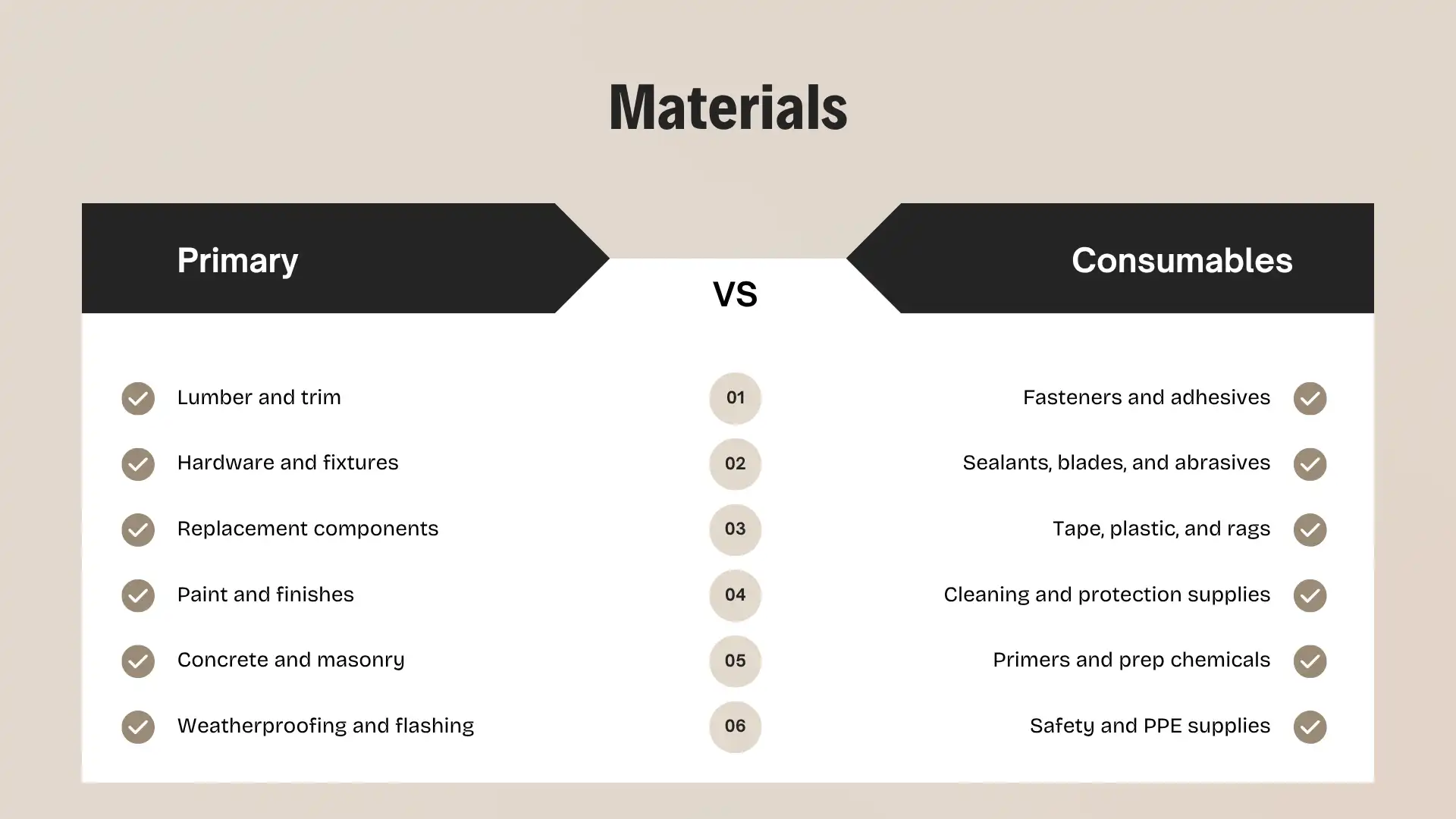
Materials fall into two buckets, and both add up faster than you’d expect.
Primary materials
- Lumber and trim
- Hardware and fixtures
- Replacement components
- Paint and finishes
Consumables
- Fasteners and adhesives
- Sealants, blades, and abrasives
- Tape, plastic, and rags
- Cleaning and protection supplies
Unfortunately, none of it just shows up on its own.
It takes some research to find the right match, a supply run or an order, checking what arrives before I install it, sometimes a return trip if something’s off, then loading and hauling it all to your property.
Consumables especially sneak up on you.
A single caulk cartridge or box of screws looks like nothing on its own, but across a year of jobs those small costs add up to a real number that has to show up somewhere in the price.
Setup, Protection, Cleanup, and Disposal
Protecting your home and cleaning up after myself is its own block of time: floor protection, covering or moving furniture, keeping dust contained, setting up ladders safely, staging materials, and being careful around your landscaping. Then vacuuming, sweeping, packaging debris, hauling it out, and covering disposal fees where they apply.
On a small project, setup and cleanup can take as long as the repair itself.
I’d rather spend that time than leave your home messier than I found it.
It’s real time either way, and it’s built into the price rather than treated as an afterthought.
- Floor, furniture, and landscaping protection before work starts
- Dust containment and safe ladder or work-area setup
- Vacuuming, sweeping, debris hauling, and disposal
Business Overhead
Overhead isn’t tied to any single fastener or labor hour on your specific job. It’s the ongoing cost of running a business that can actually show up reliably and back up what it does.
Overhead is what it costs to keep my business insured, equipped, organized, responsive, and able to stand behind completed work.
That covers liability insurance, commercial vehicle insurance, licensing, registration, accounting and bookkeeping, phone systems, scheduling and estimating software, the website, payment processing, storage, ongoing training, safety equipment, taxes, compliance, marketing, and being ready to take care of a warranty callback.
Every project chips in a share toward keeping all of that running.
None of those costs show up as a line item on your invoice, but they’re the reason I can carry insurance, respond to your requests quickly, and still be around next year if something I installed needs a look.
- Liability and commercial vehicle insurance, licensing, and compliance
- Software, phone systems, storage, and administrative costs
- Training, safety equipment, taxes, and warranty support
Tools and Equipment
Every tool I own gets bought, kept up, eventually repaired, and replaced when it wears out.
Batteries, blades, sharpening, calibration, and safety gear all cost money over time, including specialty tools I might only reach for a few times a year but need on hand when a job calls for them.
Keeping a full set ready and in good working order is part of what lets me handle a wide range of projects without turning your job into a shopping trip.
You’re not paying for the tool itself, but your project depends on that tool being ready when I need it.
Non-Billable Time and Scheduling Capacity
Not every hour I work fits neatly onto an invoice.
Maintaining tools, organizing the vehicle, restocking supplies, training, following up on quotes that never turn into jobs, cancellations, weather delays, gaps between appointments, bookkeeping, and a wasted trip to a supplier that didn’t have what I needed all take real time.
A short task can end up filling an entire appointment window even when the visible work only takes a fraction of it. That’s normal for any service business, and it means the hours that do get billed have to responsibly cover the ones that don’t.
- Tool maintenance, restocking, and vehicle organization
- Follow-up on estimates, cancellations, and weather disruptions
- Bookkeeping and unsuccessful supplier trips
The Service Call
A Service Call covers reviewing your project, scheduling the visit, loading the vehicle, driving to your property, setting up, doing the actual work, cleaning up, documenting what was done, and invoicing. Even the smallest task carries all of those costs.
The Service Call reflects what it actually costs to send a properly equipped and insured business to your property.
I include the Service Call in the written estimate so you can see it up front and decide whether it makes sense to bundle in other items from your list.
Combining a few small tasks into one visit is often the smarter way to use that trip, since you only cover one Service Call instead of one per item.
Complexity, Risk, Warranty, and Profit
Some projects carry more risk than others, and that shows up in the price too.
Working off a ladder on the second story, squeezing into a cramped crawl space, or matching a finish on a house built before certain materials were standard, all of that adds real difficulty that a flat per-hour number doesn’t capture on its own.
Complexity and risk
- Working at height or in restricted access
- Fragile finishes or older construction
- Poor prior repairs or concealed conditions
- Difficult finish matching or dependent project stages
Warranty and sustainability
- Contingency for the unexpected
- Callback and warranty responsibility
- Equipment replacement and reserves
- Stability through slower seasons
Profit is what lets me stay available, keep improving the business, absorb the unexpected, and stand behind the work I’ve already finished.
Example: Visible Labor Versus Total Project Time
To make this concrete, here’s an illustration of how the hours can break down on a small repair.
(This is meant to show the shape of a project, not a formula I apply to every job or a promise of how long your specific project will take.)
| Project activity | Example time |
|---|---|
| Planning and estimate preparation | 0.5 hour |
| Loading and material preparation | 0.5 hour |
| Round-trip travel | 1.0 hour |
| Setup and protection | 0.5 hour |
| Visible repair work | 2.0 hours |
| Cleanup, reload, and documentation | 0.5 hour |
| Total project time | 5.0 hours |
Two visible hours, five total hours.
And that total still has to contribute toward vehicle costs, tool ownership, insurance, software, overhead, taxes, the non-billable time in between jobs, and a fair, sustainable profit margin.
That’s the real math behind a quote that might otherwise look surprising for “just” a two-hour repair.
Change the project, and the ratio changes too, but the pattern holds: the visible repair is rarely the whole story.
With that said, here’s what I provide for all the customers I work with.
What Goes Into the Written Quote
The details above give you a pretty clear idea of how I price a job. But you don’t need to see all my internal math, margins, or overhead to feel good about a price.
In every quote I send, I explain what I’m assuming going in, what’s not included, how the price is put together, and how changes get handled if something comes up.
Some might call me crazy, but they’re not the ones deciding which stranger to welcome into their home.
My customer is.
And it’s my responsibility to earn and maintain their trust from start to finish, because that trust begins with the quote.
Here’s what’s in every quote I send, and why each piece matters to you as the one reading it.
1. Project Summary
A short rundown of your concern, the condition I found, the result you’re after, and my general plan for getting there.
You could hand this section to a spouse or family member and they’d understand the project in thirty seconds, no need to read the rest.
2. Detailed Scope of Work
Exactly what gets removed, repaired, installed, or touched, what prep is included, how it’s finished, and what “done” looks like when I’m through.
This is the part worth reading closely. It’s what you’re actually paying for. If something you expect isn’t listed here, that’s the time to ask, not after the work’s finished.
3. Materials and Allowances
The specific products and specs I’m planning to use, any finish assumptions, allowances built into the price, anything you’re picking out yourself or supplying, and how the price adjusts if a selection changes.
4. Assumptions
Every quote rests on a few assumptions: the framing’s in decent shape, a matching product is available, nothing’s hiding behind the surface, the utilities work, the area’s reasonably easy to access, and remote measurements are accurate.
I name these upfront so if one turns out to be wrong once I’m on site, we both already know it was an assumption, not a surprise I sprang on you.
5. Exclusions
What’s not included matters just as much as what is: concealed damage, painting beyond the repaired area, permits, work for a specialist trade, hazardous materials, restoring landscaping, or moving unusually heavy items.
Listing exclusions up front keeps things clear later, and it’s usually what prevents the most frustrating kind of mix-up: you assumed something was covered, and I assumed it wasn’t.
6. Optional Work and Alternatives
Where it applies, I’ll lay out repair versus replacement, a base scope with optional upgrades, good-better-best product choices, or a temporary fix versus a permanent one, so you can weigh the trade-offs yourself. I’ll give you my honest take, but the decision is always yours.
7. Price, Payment, and Estimated Schedule
The fixed price or allowance, any optional pricing, applicable tax, and a realistic timeline including material lead times and how many visits the project’s likely to take.
I take cash, check, Venmo, Zelle, and credit card. Payment’s due at completion for most jobs. For larger projects I might ask for a partial deposit upfront, and if so, that’s spelled out in the estimate, not sprung on you at the end.
Knowing the schedule up front, not just the price, is what lets you plan around the work instead of wondering when your house will feel like home again.
8. Change Conditions and Approval
If I find something unexpected once work’s started, I stop where it makes sense to, document what I found, walk you through the options, and get your okay before doing anything more or spending anything extra.
9. Customer Responsibilities and Follow-Up
What I need from you: access to the work area, arrangements for pets, moving personal items out of the way, making any selections on time, working utilities, and a heads-up on any association rules.
Afterward, expect a final walkthrough, photos, and an invoice that doubles as your receipt.
If you need it in a specific format for a home warranty provider, insurance company, or your own records, just say so and I’ll make sure it’s got what you need.
All labor is warrantied for one year from completion against defects in workmanship under normal use.
That doesn’t cover normal wear and tear, damage that happens after the fact, acts of nature, materials you supplied yourself, or manufacturer defects, which fall under that manufacturer’s own warranty instead.
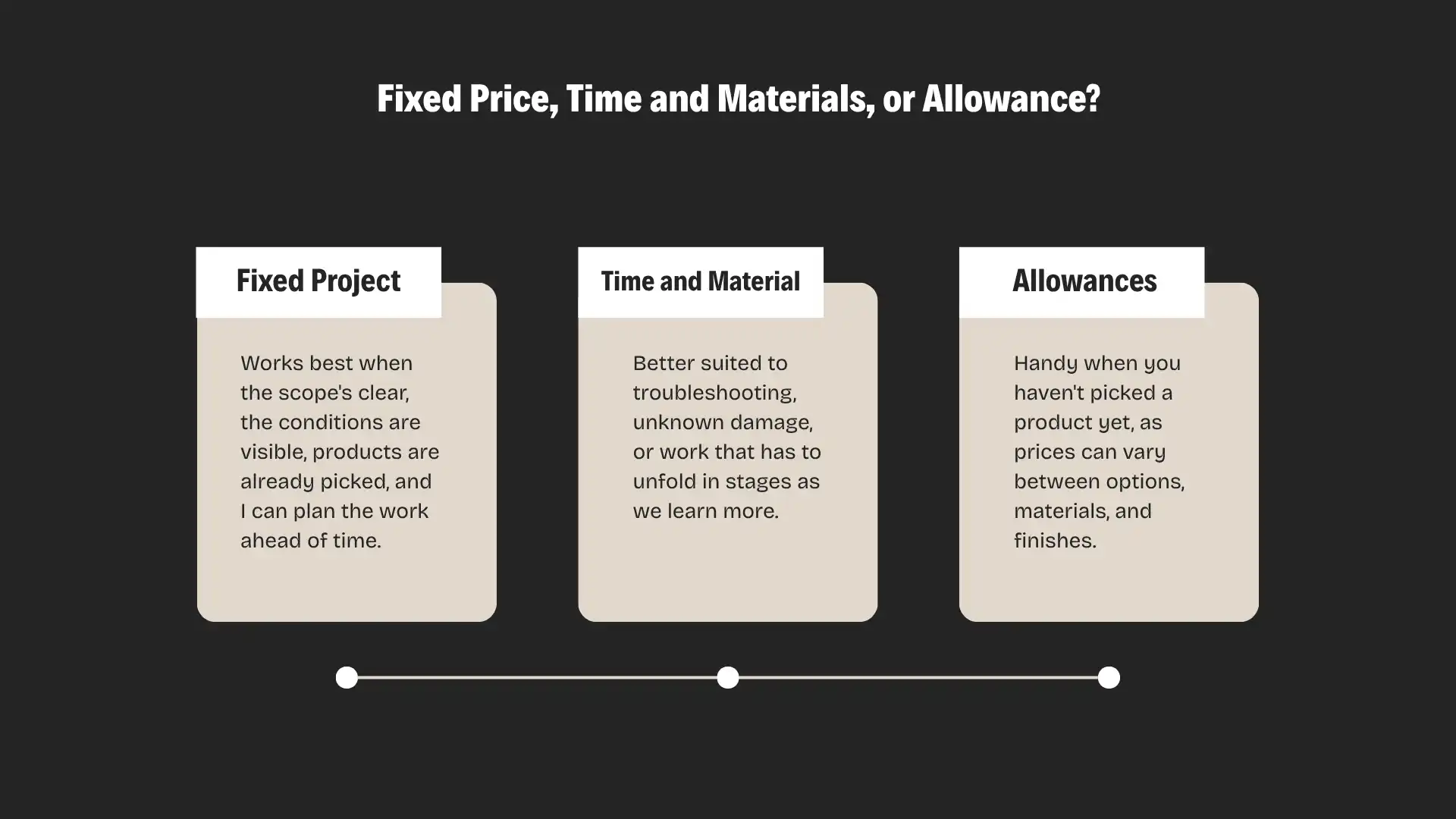
Fixed Price, Time and Materials, or Allowance?
Not every project comes with the same amount of certainty going in, and the pricing should match that.
Here are the three formats I use, depending on the job.
It’s not about which one’s cheaper. It’s about which one honestly fits how much we actually know before I start.
Fixed Project Pricing
Works best when the scope’s clear, the conditions are visible, products are already picked, and I can plan the work ahead of time.
You get a firm number, easy budgeting, and no guesswork on the final invoice. This is what I use for most standard repairs and installs.
Time-and-Material Pricing
Better suited to troubleshooting, unknown damage, or work that has to unfold in stages as we learn more.
I set checkpoints and a spending limit up front, and I check in with you before going past it. I only use this when a project genuinely calls for it (it’s rare), so when I do, I’ll tell you why before I recommend it.
Material Allowances
Handy when you haven’t picked a product yet, prices vary between options, availability’s uncertain, or finish decisions are still open.
I build in a fair allowance, and the final price adjusts once you’ve settled on something or the project wraps up, whether that means a credit adjustment or a small increase.
Why Two Quotes for the Same Project May Be Different
If you’ve collected more than one quote for the same project, you’ve probably noticed the numbers don’t match.
Sometimes by a wide margin.
That gap is rarely about one contractor being greedy and another being generous.
It usually comes from real differences in how the scope was interpreted, how much preparation is included, the grade of material specified, the repair method chosen, the level of finish work, whether cleanup and disposal are included, insurance and licensing costs, warranty terms, where materials are sourced, what assumptions were made, what’s excluded, whether any of the work gets subcontracted out, and how much overhead each business is carrying.
Two contractors can walk through the same house and come away planning genuinely different projects, not because one of them is wrong, but because they made different calls about what the situation required.
That’s normal.
It’s also exactly why the total by itself doesn’t tell you much on its own.
Compare the Scope Before Comparing the Total
Before you decide based on price alone, I always suggest lining the quotes up side by side to check what each one actually covers. It takes an extra ten minutes, and it’s the single best way to avoid picking a quote that looks cheaper on paper but turns into a worse deal once the work starts.
- What work is included, step by step
- What specific products or specifications are named
- What assumptions the contractor is making
- What’s explicitly excluded
- Whether cleanup and debris disposal are included
- How changes and unexpected conditions get handled
- What warranty or follow-up support is offered
- Whether anything is listed as optional versus required
A lower quote isn’t necessarily less expensive if it’s missing important parts of the project.
What I Don’t Add to a Quote
Being responsible about estimating isn’t just about what I include.
It’s also about what I leave out.
I don’t add unnecessary upgrades you didn’t ask for, work outside what I’m competent or licensed to do, hidden line items, vague miscellaneous charges, premium products that don’t offer any real benefit for your situation, work that can reasonably wait, jobs that should go to a specialist trade instead of me, or optional work presented like it’s mandatory.
If something falls outside my wheelhouse like electrical, major plumbing, or HVAC, I’ll say so directly and point you toward a licensed specialist rather than stretch my own scope to cover it.
- No upgrades you didn’t ask for and don’t need
- No vague “miscellaneous” charges
- No work outside my competence or license passed off as routine
- No optional item disguised as required
Being responsible about estimating also means telling you what doesn’t need to be done.
I’d rather tell you a repair will hold up fine than talk you into a full replacement you don’t need yet. Recommending less work when less work is the honest answer is part of how I keep customers coming back for the next project instead of just this one.
What Happens After the Quote Is Approved
Approving a quote isn’t the end of the conversation.
It’s the start of a sequence that carries the project from paper to a finished result, and I keep you in the loop at every step rather than disappearing until the work’s done.
- Selections are confirmed. Product, finish, color, hardware, anything you’re supplying, and allowance choices get locked in.
- Materials are ordered or reserved. I check availability and lead times, handle any substitutions, inspect what arrives for damage, and arrange delivery or pickup.
- The project is scheduled. We agree on arrival time, what access I’ll need, roughly how long the work will take, and how to prep the work area beforehand.
- Changes are documented. If the scope or price shifts for any reason, we talk it through and I get your approval before moving forward.
- Completion is documented. Final photos, a written summary of the work, and product information, along with any care or maintenance notes worth keeping an eye on down the road.
Selections often take longer to pin down than people expect, especially when a finish or fixture needs to match something already in the home, so I try to lock those in early rather than let them hold up scheduling.
Once materials are ordered, lead times are mostly out of my hands, but I’ll let you know as soon as I have a real delivery window so we can pick a date that works.
If anything changes once I’m on site, I document it the same way as the original quote: in writing, with your okay before I move forward. And when the work’s done, you get more than a handshake and an invoice. You get a record of exactly what was done, so if a question comes up six months later, neither of us has to rely on memory.
The Goal Is Fewer Surprises
A detailed estimate does more than set a price.
It sets clear expectations.
It defines exactly what work is happening. It gives you something real to compare against other quotes. It makes any later change easy to spot and discuss. It creates a written record for both of us.
That protects you, and it protects me too.
That’s really the point of writing a quote this way in the first place.
None of this makes a project immune to surprises. Old houses hide things, and sometimes a wall opens up to something nobody expected. But a good estimate means we’re both starting from the same understanding, so if something does come up, it’s a conversation, not a dispute.
- Sets expectations before work begins
- Gives you something concrete to compare
- Makes changes easy to identify and discuss
- Creates a written record for both of us
A good quote isn’t just a number at the bottom of a page. It’s a plan for getting the project done right.
Frequently Asked Questions
A few questions I hear often when I’m walking a homeowner through a quote, answered here in plain terms.
Why do some projects require an in-person visit?
Photos and descriptions only tell me so much. Measurements, hidden conditions, access, and how something was originally put together usually need a direct look before I can give you an accurate scope and price instead of a rough guess. Anything involving structure, moisture, or an unfamiliar setup usually falls in this category.
Do you charge for estimates or project assessments?
For most jobs I can give you a ballpark from a description or a few photos, no charge. For bigger or more complex projects, I might need a quick on-site look first, and I’ll tell you upfront if that comes with a fee. For most residential handyman work, it doesn’t.
Are materials included in the quoted price?
Yes, in most cases. Materials are either built into the fixed quote or included as an allowance, and either way it’s spelled out in the written quote so you know exactly what’s covered before I order anything. If you’d rather supply certain items yourself, we can talk through that before I finalize the price.
What happens if hidden damage is discovered?
I stop where it makes sense to, document what I found with photos, walk you through your options, and get your okay before doing anything more or spending anything extra. Nothing happens without you knowing first, and you’ll always get to decide whether to move forward, adjust the scope, or hold off.
Can I purchase or supply my own materials?
In many cases, yes. We’d talk through specifics ahead of time so what you supply fits the repair method, and the quote would reflect labor plus any materials I’m still providing separately. Just keep in mind, if something you supply turns out to be the wrong size or spec, it can affect the schedule.
Why does a short repair still start as a Service Call?
Even a fifteen-minute repair carries the full cost of planning, driving over, loading and unloading tools, setup, and cleanup. The Service Call reflects the cost of showing up properly equipped, not the size of the repair. It’s the same reason a plumber or electrician’s dispatch fee doesn’t shrink for a quick fix.
Will the final invoice match the approved quote?
For fixed-price work, yes, unless we agreed to a documented change along the way. For allowance or time-and-material work, the invoice reflects your actual selections or hours within whatever limits we set together upfront. Either way, you’ll never see a total on the invoice that hasn’t already been talked through with you.
How long is a quote valid?
Every quote’s good for 30 days from when I send it. Material costs shift, so if more time passes before you’re ready to move forward, just send me a message and I’ll take another look and update the numbers if anything’s changed.
If you’ve got a project in mind, you can start an estimate request here. No pressure, no obligation. Just a clear next step.
If you’ve made it this far down the page, I just want to say thank you.
I’m building Bedrock in the open in a series called Inside Bedrock (or Bedrock Uncovered, I’m still undecided).
Open startups were popularized in the tech space, but I’m bringing it to my home service business.
Some things I share:
Monthly business updates
Processes I’m improving
Why I changed a certain system
Lessons from recent projects
Service metrics
New equipment or software decisions
Mistakes and corrective actions
It’s my little way of remaining accountable, transparent, and a trustworthy neighbor you’d want working inside your home.
-NC