
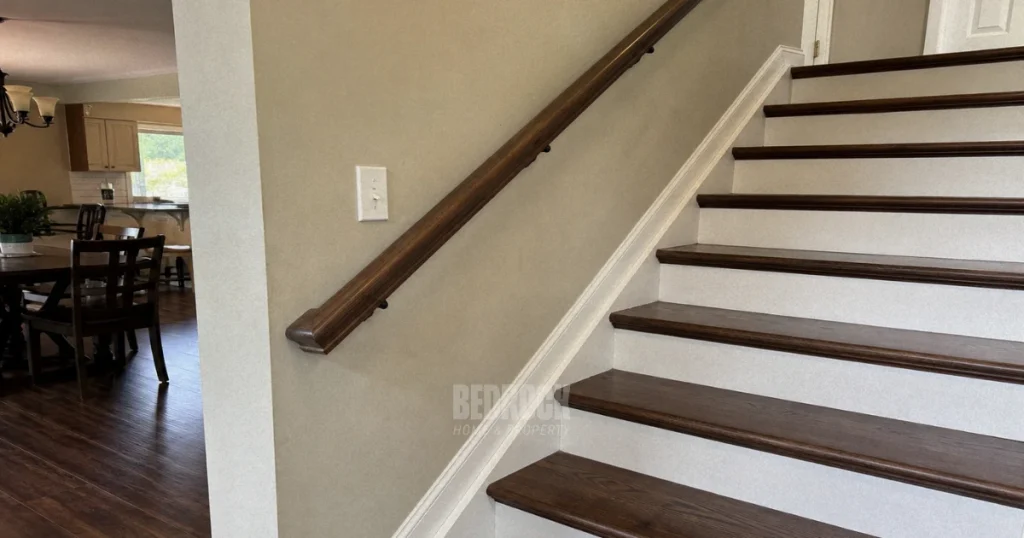
Professional handrail installation for interior stairs, exterior steps, and deck stairways.
How I Can Help
Tasks Not Typically Included
Included With Every Job
How It Works
Why Trust Bedrock for Handrail Installation
Owner Operated Service
Direct One-on-One Support
Transparent Solo Pricing
Personally Guaranteed Work
Handrail Installation FAQs
A standard interior wall-mounted rail on an existing stairway fits inside a $250 service call. Exterior rails and deck stair rails take longer, especially with concrete anchoring. The calculator gives your exact range in about a minute.
IRC requires handrails to have a graspable profile — either a round rail with a 1.25–2 inch diameter, or a shaped rail where your hand can wrap around and grip it. Flat 2×4 lumber nailed on edge doesn’t qualify. I use proper handrail profiles rated for residential use so the installation meets code and actually functions as a safety grip.
Yes. Exterior concrete step handrails are mounted using expansion anchors or core-drilled post bases, depending on the configuration. This is a common request in Hastings for older homes with steep front or side entry steps and no existing rail.
When studs aren’t in the right location for bracket placement, I install blocking behind the drywall to provide solid backing. This is the correct fix — toggle bolts and drywall anchors are not adequate for a load-bearing handrail.
Yes. Adding or reinforcing handrails is one of the most common aging-in-place modifications I do. I look at both the stair handrail and any transition areas where an extra grip point would help, and I make recommendations based on what I see during the assessment.